Units of Sound

Introduction
Overview
Units of Sound is a structured, cumulative literacy intervention program which starts with all 26 letters of the alphabet. At the beginning, it concentrates on vowels and consonant vowel consonant (cvc) words: for example, mat or dog.
The program was originally developed for audio-cassette and book format by Walter Bramley, but has since been developed and extensively revised by Dyslexia Action, and, subsequently, Nisai Group.
Much of the work is conducted independently by the students with tutors taking a monitoring role.
We continue to use the book metaphor to describe Units of Sounds - three books, or Stages:
- Stage 1 (52 pages) – from cvc words.
- Stage 2 (48 pages) – from blends and digraphs.
- Stage 3 (48 pages) – multisyllable words.
Content
Units of Sound teaches reading (emphasis on decoding), spelling and writing skills.
There are separate placement tests for reading and spelling, as many students do not have the same skills levels in these areas. Students are placed where they are working comfortably, not where they are struggling.
No spelling rules are taught overtly. Instead, Units of Sound focusses on teaching auditory and visual patterns, rather than individual words. The only exceptions are irregular words, which are dripped into the program when they are needed, or are similar to the patterns on the page.
Revisiting is a guiding principle of Units of Sound so that students learn in the most natural way.
Each unit of sound occurs in all four programs, so the student meets the words and sounds in different settings. By the time any word appears in Dictation, the student should feel confident in reading, spelling and writing it.
Who is Units of Sound for?
Units of Sound is for anyone who needs help with decoding, spelling and writing.
- It is used widely with students from around 8 years to adult.
- Care should be taken with students under 8 years old to ensure they need a second chance program, rather than more of the initial teaching of reading.
Units of Sound can be beneficial for students with English as a second language because of its multisensory, overlearning nature, and the pronunciation recording feature in Reading.
The structure of Units of Sound and lack of analysis makes it a valuable tool for students with a wide range of abilities and literacy difficulties.
What do I cover in a week?
The time a student spends on Units of Sound in a session will depend on: how much time is available, the student’s age and ability and the level of need.
A common pattern is for students to cover 2 new pages of both Reading and Spelling each week, although it is possible to have a more intensive intervention, especially for older students.
Use what time is available: regular sessions are important. Independent work can be carried out at home or out of curriculum time in addition to time with a tutor.
There are many models, depending on time and circumstances: e.g from three or four sessions of 20-30 minutes a week, to two sessions of 45 minutes a week, to Units of Sound being used as part of specialist lessons of an hour and a half. There is no right or wrong model.
Auto Route determines the order in which the student follows the program.
What does the tutor do?
The tutor’s role is vital in the smooth running of the lesson and establishing a positive learning environment.
- The tutor carries out
Setup and Placement. - The tutor conducts the
Reading Check, which informs the pace of the route through theReadingprogram. - The tutor’s aim is to guide the student through the program without the student experiencing failure or frustration.
Units of Sound does not involve micro-planning for each lesson, therefore the tutor has more time to provide additional, individualized work for those students with more profound needs.
Student ratio
A 1:1 tutor-student ratio is rarely necessary and is not recommended for mainstream students as much of the work is independent work on the computer.
Units of Sound is designed so the student works and learns independently, but with support in a secure framework.
Independent work develops active learning in students.
Support for students includes the Screen Tutors, which demonstrate each new activity. One of the benefits of independent work is that students develop confidence in their own ability to learn and not become tutor dependent.
The tutor-student ratio will vary according to the severity of the student’s learning needs, behavioural considerations and staff availability.
- Small group work can generate a positive learning environment, which allows 1:1 work for short periods as needed.
- Group work with team teaching is probably the ideal situation with 2:6 or 2:10 ratios.
Tutors will soon learn which is the best model for their environment. It is better to start with a small group and expand once tutors are confident with using Units of Sound.
Lesson planning
Introductory lessons
Students in their first Units of Sound lesson will not know what to expect, or what to do.
The Reading and Spelling Placement is carried out first to place the student at the right level. This is best carried out with one or two students at a time. Remember, you can add students to the register in advance.
Once Placement is complete you may wish to get the student to read the passage in the Reading Check set that is prior to the Reading Check set due.
The Reading Placement allows you to see the student’s single word decoding skills, and the Reading Check passage gives you an idea of their fluency – you can decide to set them back if necessary.
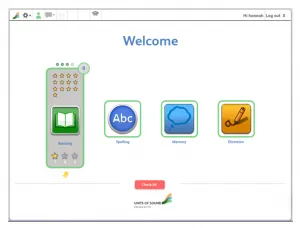
You can now explain the Welcome screen to the student and show them Overview. This gives the student a sense of their starting point and goals.
If you are starting with a group, you may like to begin by showing the screen tutor for Reading Blocks, which covers a lot of the basics.
Alternatively, you can demonstrate the actions yourself.
It’s easier to keep Auto Route off in the first few sessions so the student can work on the skill that you have demonstrated. Once all skills have been covered, we recommend switching Auto Route on.
Practice
Placement sets the individual’s program and automatically keeps a record of the pages completed. See Student Management / Setup: Placement for full details.
If you select Auto Route, the sequence of skills the student will work through will be pre-set, freeing the teacher from monitoring this aspect of the work.
In this way the student or tutor does not have to worry about which skill to go on to as the program will automatically highlight the next skills area.
The page number to be worked on can be overridden at any time by the tutor by setting the page in Student Management.
Jump to can be used to go to a page the tutor wants the student to cover again, if, for example, Reading Check highlights difficulty with a particular sound.
In this way control remains in the hands of the tutor.
A full Units of Sound lesson may well include a Reading Check,(section 05), Writing Exercises, (section 09), or other support activities.